Transcription
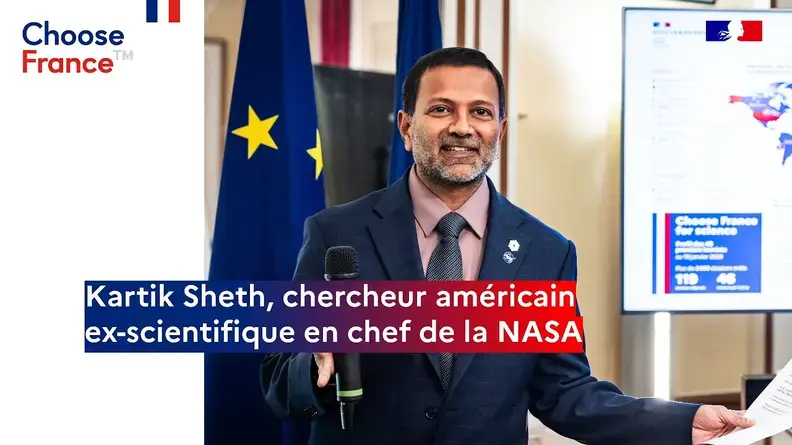
Kartik Sheth : The story begins on 10 March 2025, completely out of the blue. I was deputy chief scientist at NASA when we received a message announcing that our entire department, that of the chief scientist and that of technology, policy and strategy, was being abolished. These two major structures were responsible for
advising the administrator on all aspects of science and technology. Receiving such news came as a real shock. The biggest challenge was that, overnight, I found myself unemployed and didn't know how I would be able to continue my work. The Choose France for Science programme and the Safe Place for Science programme in Marseille are two wonderful opportunities for me to continue my research.
My name is Kartik Sheth. Until recently, I was Deputy Chief Scientist at NASA, where I worked on astrophysics and Earth sciences. Before joining the government ten years ago, I had a long academic career that lasted nearly twenty years. I was an astrophysicist and my great passion was studying the evolution of galaxies.
Galaxies are the fundamental building blocks of the Universe. We live in the Milky Way galaxy. The question is: how did this galaxy come into being? When did the first galaxies form? How have they changed over time, and how did we get to where we are today? To study all this, I work on barred spiral galaxies. I don't know if you're familiar with Star Wars, but imagine a TIE fighter. A barred spiral galaxy looks like a TIE fighter. There is a bar of stars in the centre and spiral arms at each end. Today, we know that two-thirds of known galaxies are barred spiral galaxies.
But what did they look like in the past? This is important because the presence or absence of this bar indicates the maturity or age of a galaxy. So we did a lot of work with the Hubble Space Telescope, the Spitzer Telescope and ground-based telescopes. In 2008, I had to stop my research because that was the limit of what Hubble could observe. Then, two years ago, the Ariane rocket launched the James Webb Space Telescope. It's an extraordinary moment to go back 7 billion years, to the beginning of time, and understand how the first galaxies formed. The second part of my research focuses on star formation. One of the most fundamental processes in the evolution of the universe is the transformation of gas into stars. To observe this phenomenon, we use radio telescopes such as the Atacama Large Millimetre Array and the Square Kilometre Array. France is participating in both projects. Thanks to these telescopes, we are studying the gas and dust from which stars and planets are born. This has been a major part of my research in the past, and I hope to continue it when I arrive in France.
It offers me tremendous initial support, which will enable me to build a team with students and postdoctoral researchers. It also provides the means to organise scientific meetings between the United States, France, Europe, Asia and Africa, so that we can come together and advance international science. I am also very enthusiastic about the idea of living in another country. Travelling back and forth, learning French, discovering French culture and drawing inspiration from it is exciting.
When I talk to my French colleagues, I really appreciate their approach to work-life balance. At my age, family is essential. So I appreciate the flexibility of the French and European systems.