Lucas Rovige: at the heart of laser-plasma acceleration
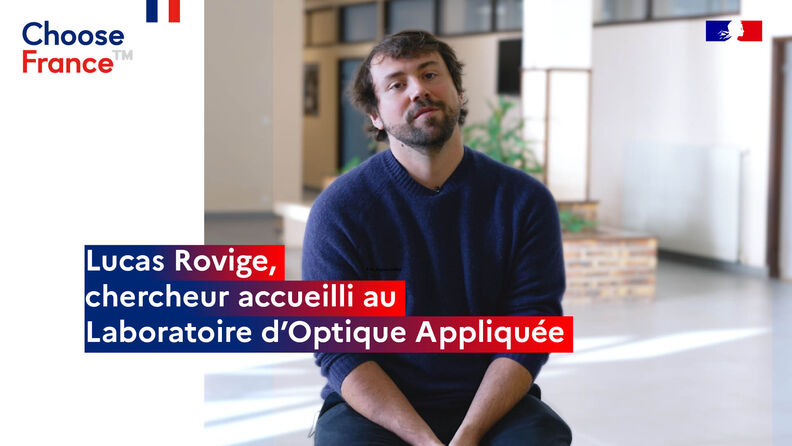
As part of the Choose France for Science programme, Lucas Rovige is a visiting researcher at the Laboratory of Applied Optics (LOA) at the Institut Polytechnique de Paris.
A path to cutting-edge research
Lucas Rovige studied physics at the Institut Polytechnique de Paris, and was awarded a PhD in 2022 at the Laboratory of Applied Optics. His thesis focused on the optimisation and control of plasma laser accelerators, an innovative technology capable of accelerating electrons to relativistic speeds over very short distances.
After a postdoctoral fellowship at the University of California, Los Angeles between 2022 and 2025, he joined the CNRS in 2025 through the Choose France for Science programme as a research fellow, continuing his work on laser plasma acceleration using ultra-intense lasers.
« At the CNRS, we enjoy a great deal of freedom. We can carry out long-term research and experiments while benefiting from the security, stability and support that enable us to make progress and achieve significant advances. »
Lucas Rovige, researcher in laser-induced wake turbulence
Advanced research in plasma physics
Lucas Rovige’s research focuses on plasma physics and ultra-intense lasers. The aim is to improve control over the dynamics of electrons in plasma laser accelerators, a promising technology for:
- fundamental physics
- ultra-fast imaging
- medical and industrial applications
These next-generation accelerators enable the production of extremely short, high-energy electron beams.
Laser wakefield acceleration enables electrons to be accelerated to speeds close to that of light using extremely powerful and ultra-fast lasers, within equipment that is far more compact than traditional accelerators. In medicine, for example, these beams could be used to improve radiotherapy or to produce more effective X-rays for medical imaging.
Partner(s)

See also